RBQ Licensing Is Mandatory, Not Optional
In Quebec, anyone who carries out construction work for profit is required to hold a valid licence from the Régie du bâtiment du Québec. Countertop fabrication and installation falls under RBQ Licence subclass 12.0 (factory-built cabinets and countertops). A contractor without an RBQ licence is, by provincial law, not legally permitted to perform the work. More importantly for you as the homeowner: hiring an unlicensed contractor means you have no recourse if something goes wrong. No licence security, no guarantee plan coverage, no regulatory body to file a complaint with. Always ask for the RBQ licence number, always verify it on the RBQ's public registry before signing, and never accept a verbal assurance.
When a Building Permit Is Required — And When It Is Not
Straight countertop replacement that does not alter the building structure typically does not require a municipal building permit. If the project is purely surface work — cabinets stay, plumbing locations stay, electrical stays — you generally do not need to apply to your borough for a permit. However, if the countertop replacement is part of a larger renovation that includes moving plumbing, moving electrical, or opening up a wall, a permit is almost certainly required. Each Montreal borough has its own permit process (arrondissements on the island issue their own), and Laval, Longueuil, Brossard, Saint-Lambert, and other off-island municipalities each have their own building department. We always recommend confirming with your borough before demo begins.
Condo and Co-Ownership Rules
If you live in a condo building — particularly a newer Griffintown, Old Montreal, or Ville-Marie tower, or an older converted building — your syndicate of co-owners (the syndicat de copropriété) almost certainly has renovation rules in the declaration of co-ownership. These rules typically cover work hours (often 8 am to 5 pm weekdays, no weekends), elevator reservation and padding requirements, floor protection, insurance certificates the contractor must provide, and advance notice to the property manager. For larger loads like a full-slab granite island — which can weigh 400 to 700 pounds — you may also need to coordinate with building management on the elevator capacity and the rigging path from the truck to your unit.
Montreal's Climate and What It Means for Stone
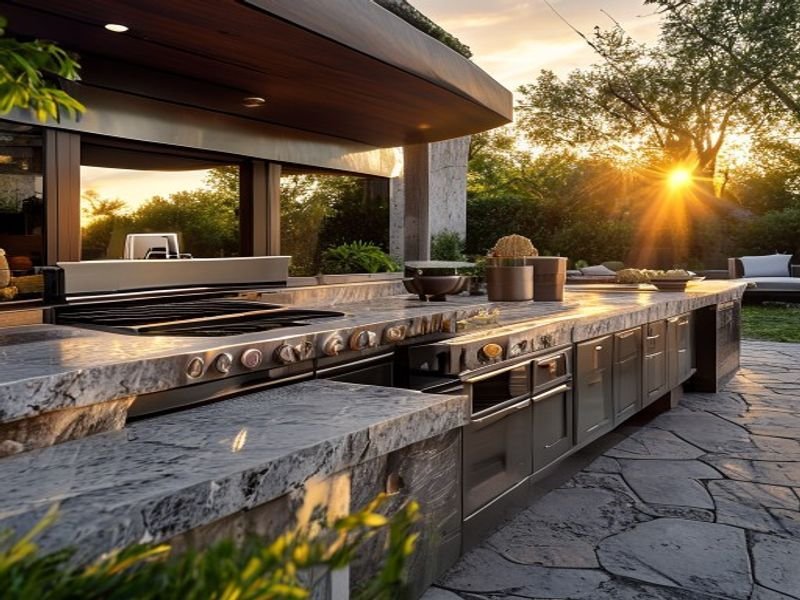
Montreal swings roughly 60 degrees Celsius between peak summer and peak winter, with dramatic humidity changes between July and February. Indoor granite is largely unaffected — natural stone is dimensionally stable, and the temperature swings inside your conditioned home are a fraction of what happens outside. But the transition matters. Slabs delivered to site in minus-twenty weather need to acclimatize for several hours before fabrication-grade handling, because a cold slab installed into a warm kitchen can develop micro-stresses. This is one of the details a Montreal-experienced fabricator handles automatically and an out-of-town shop might miss. Outdoor granite — BBQ counters, patio service counters, outdoor kitchens — needs freeze-thaw-appropriate sealing and a slab selection that resists water absorption, because every crack in the seal becomes ice during the winter months.
Older Montreal Housing Stock
A large share of Montreal's residential building stock was built between 1900 and 1960. Plateau triplexes, Rosemont duplexes, NDG detached houses, and Verdun plexes all share common renovation realities: walls that are not square, floors that slope toward the centre of the building, original plaster that is soft behind the drywall patch, and framing that was sized for a different era's loads. None of this makes a granite installation impossible — it just means the templating and scribing work has to be done by someone who has seen it a hundred times. We scribe granite to the wall contour where needed, we shim cabinets flat before the stone goes on, and we never assume the kitchen is square until we measure it.
Sales Tax, Pricing, and Deposits
Montreal countertop quotes are subject to Canadian GST (5%) and Quebec QST (9.975%), combined roughly 14.975%. A legitimate fabricator's quote will show these line-items clearly. Deposits are standard in this trade — typically 40–60% at contract signing to secure the slab, with the balance due on installation. An unusually large deposit demand (say, 90% upfront) or a request for cash-only payment are both warning signs that the contractor may not be operating legitimately.
Language and Contract Law in Quebec
Under Quebec's Charter of the French Language, contracts of adhesion and standard-form consumer contracts must be in French unless the client specifically requests a version in another language. In practice, reputable Montreal contractors provide contracts in French by default and offer English, Spanish, or other language versions on request. You are legally entitled to a contract you fully understand — do not sign anything in a language you are not fluent in.
Guarantee Plan Accreditation
For new residential construction (not applicable to countertop-only work), Quebec requires accreditation under the Guarantee Plan for New Residential Buildings (Garantie de construction résidentielle / GCR). For countertop replacement in existing homes, GCR accreditation is not required — but the contractor's general RBQ licence security and your contract terms are what protect you in the event of a dispute.